


 News Editor
From Dooshima Terkura, Makurdi
A business and vocational empowerment programme aimed at strengthening the economic resilience of women who are survivors of Gender- Based Violence (GBV) in Internally Displaced Persons (IDP) and host communities has achieved significant success major with beneficiaries already generating more than N250,000 in sales from their new enterprises.
50 Benue Women Survivors of SGBV trained in business, vocational skills
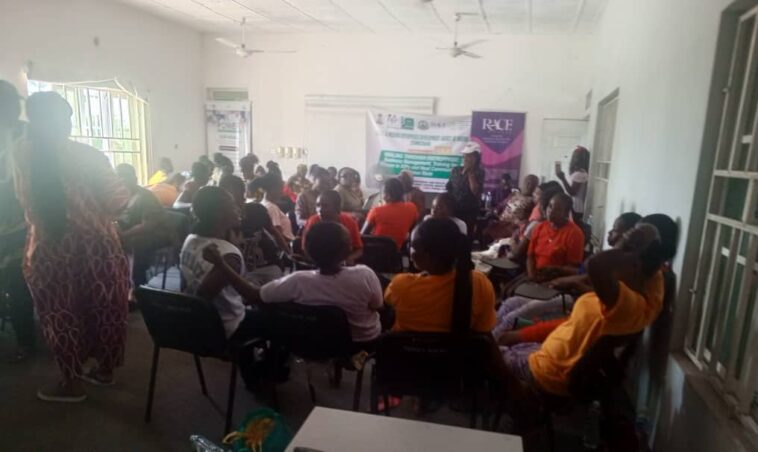
The “Healing Through Enterprise: Business Management Training for Women GBV Survivors in IDP and Host Communities in Benue State, formally launched in Makurdi, the Benue State capital by the Small and Medium Enterprises Development Agency of Nigeria (SMEDAN), have trained 50 Benue Women Survivors of SGBV with more being targetted.
The Executive Director of the Centre for Redefining Alternative Civic Engagement for Africa, Evelyn Ugbe, described the programme as “a pathway to healing, hope and transformation” for vulnerable women.
Ugbe said the training is in conformity with the global 16 Days of Activism Against Gender-Based Violence, noting that many women in conflict-affected communities carry invisible scars that undermine their ability to rebuild their lives.
She said the initiative has already equipped numerous women with vocational and business management skills that are helping them take control of their economic future.
“We have equipped numerous women with valuable vocational and business management skills, empowering them to take charge of their economic futures.
“The establishment of the TAHAV Women Cooperative Society has been a significant milestone. Several women have successfully launched their enterprises and participated in exhibitions, showcasing their talents and products”, she added.
Ugbe revealed that the women had collectively recorded sales exceeding N250,000 from their products, which she described as “a testament to their resilience and potential.”
“As we celebrate these achievements, I make a heartfelt appeal for partnership with government agencies. Together, we can create an environment that enhances the ease of doing business for these women. By streamlining processes and offering resources, they can thrive and contribute meaningfully to rebuilding their communities,” Ugbe stated.
She stressed that women in IDP communities are “critical agents for rebuilding their neighborhoods and futures,” urging all stakeholders to use technology as a tool of empowerment, not a weapon that harms women.
The Executive Director also commended SEMDAN, GERI, and other partners for their commitment, while expressing gratitude to the Embassy of France in Nigeria for supporting the initiative adding that “Healing isn’t just about recovery; it’s about reclaiming hope and rebuilding lives.”
In an interaction with newsmen, the Executive Director of the Gender and Environmental Risk Reduction Initiative (GERI), Mrs. Elizabeth Jeiyol, explained that the training was part of a broader programme known as the POWER Project, Promoting Women’s Economic Resilience in Conflict-Affected Communities.
Jeiyol who spoke through her Assistant, Stephanie Tamang, said “What is taking place here is like a small part of a bigger project. It’s called the Power Project. We are empowering 50 IDP women and women from the host community in Daudu, 40 IDP women and 10 from the host community, to ensure everyone is well represented,” she said.
Tamang noted that the beneficiaries are being trained in vocational, economic, and financial management skills to ensure sustainability. “Most times, if you give them money, once the money finishes, that’s all. But when you empower them, they can use what you’ve given them to grow their businesses and empower others.”
She said the day’s activity focused on business skills training. “We want them to know what it takes to run a business, what it takes to legalize their business. It’s called Healing Through Vocational Training.”
Explaining how beneficiaries were selected, Temang said that GERI conducted a needs assessment at the start of the project. “Initially, we wanted to work with 100 women, but due to funding constraints, we scaled down to 50. One of the most important things is targeting GBV survivors and female heads of households because many have lost their husbands or fathers.”
She added that they worked closely with key stakeholders such as SEMA, traditional rulers, the Ministry of Women Affairs, Ministry of Trade and Investment, Ministry of Humanitarian Affairs and Disaster Management, and SMEDAN to select the beneficiaries.
At the training, representatives of NAFDAC, the Corporate Affairs Commission (CAC), and SMEDAN took participants through procedures needed to formalize and grow their businesses.
The representative of NAFDAC, Wanger Akange, advised the beneficiaries to register their products for proper monitoring and approval, while CAC representative, Simon Ayangeor, encouraged them to register their business names.
Mr John Adah, General Manager, SMEDAN assured them that the intervention they received qualified them for future government support schemes.
Some beneficiaries who shared testimonies of how the training has transformed their lives, Nguhiden Ugber from Daudu, trained in catering and baking, said the programme expanded her skills and mindset. “I was into baking before but it was just for consumption. When I wanted to do it as a business, I needed training and the training has helped me a lot. My mentality has changed. They have taught us how to manage money and how to save.”
Another participant, Miss Dorcas Shaaho from Daudu IDP Camp 2, said she has become more financially stable through tailoring.
She said “The way they taught me, I can sew clothes and bags. This December, I will sew children’s clothes and take them to the market. Their training has helped me a lot because now I can send money to younger sister in school and give my mother money to buy food,” thanking the French Embassy and GERI for their support.
Facilitators, government agencies, humanitarian organisations, and community representatives, came together in support of displaced and vulnerable women to rebuild their livelihoods through enterprise.
Call to donate, sponsor posts or for advert placements on our website.
Tel: +234 815 089 8880.
Thank you!