


 News Editor
By David Odama
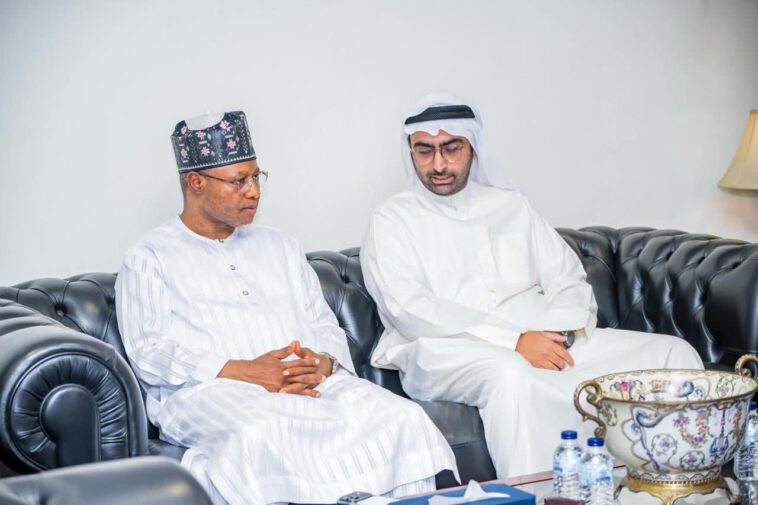
Kaduna State Governor, Senator Uba Sani has secured fresh momentum for the $62.8 million Reaching Out-of-School Children (ROOSC) Programme and broader development financing after a high-level meeting with the Director-General of the Kuwait Fund for Arab Economic Development (KFAED), Dr. Waleed Al-Bahar, in Kuwait City.
The Governor, who conveyed the gratitude of the government and people of Kaduna State, reaffirmed his administration’s commitment to deepening the partnership that has made Kaduna the first Nigerian state to benefit from Kuwait Fund support. The ROOSC initiative—jointly backed by KFAED, the Islamic Development Bank (IsDB), the Global Partnership for Education (GPE), Education Above All (EAA), and Save the Children International—remains one of the most ambitious education recovery programmes in the country, targeting more than 100,000 out-of-school children and benefitting over 1.2 million learners across all 23 LGAs.
Governor Sani briefed the Fund’s leadership on the remarkable progress already recorded under the programme, including the identification and mapping of 79,275 out-of-school children across 14 LGAs, the enrolment of 13,756 learners—surpassing the Year One target of 10,000—and the training of 1,300 teachers, alongside the distribution of more than 35,000 learning kits. He added that civil works are advancing steadily, with 170 schools undergoing rehabilitation and 102 new ones under construction.
He appealed for swift release of the next tranche of funds to accelerate implementation, stressing that every week gained pushes Kaduna closer to delivering safe, modern, and high-quality learning environments for thousands of children.
Beyond education, the Governor tabled Kaduna State’s new priority areas for funding support, including the upgrading and solarisation of between 255 and 500 Primary Healthcare Centres; expansion of rural infrastructure such as roads, electrification, water supply, and sanitation systems; and a comprehensive agricultural modernisation drive involving mechanisation, irrigation, climate-resilient inputs, processing centres, and youth and women agribusiness initiatives.
Dr. Al-Bahar praised Kaduna’s transparency, reform-focused governance, and commitment to inclusive development. He welcomed the new proposals, reaffirming KFAED’s readiness to explore additional support for health, agriculture, and infrastructure.
Other senior officials present at the meeting included Thamer Alfailakawi, Director of Operations; Khaled Salah Al-Marzouq, Project Coordinator for West Africa; and Rawya Alawadhi, Project Engineer.
Both sides closed with a firm commitment to fast-track all ongoing projects and broaden cooperation that will positively transform the lives of millions of Kaduna residents.