


 News Editor
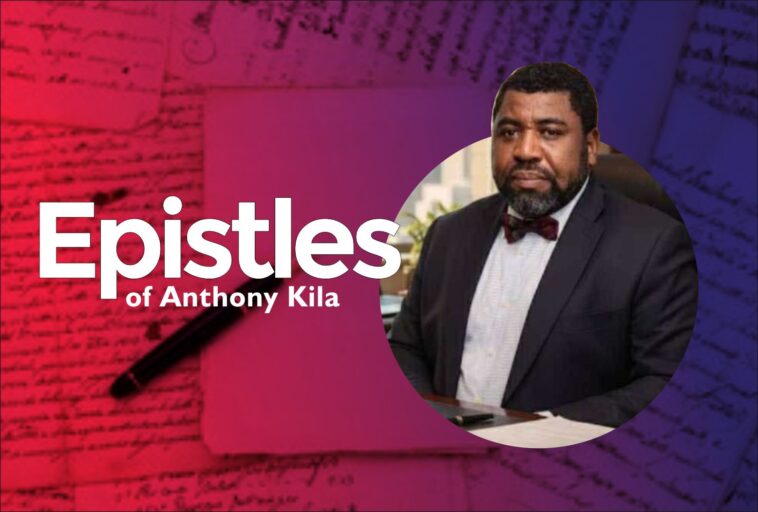
In this epistle, Anthony Kila reflects on the interview granted by Presidential Spokesman, Daniel Bwala, and concludes that the President is to blame.
Dear Readers,
Beyond the usual hustle and bustle that fill our daily lives and the anxieties caused by the dangerous escalation from the recent attack on Iran by the United States and Israel, there is one event that has recently captured the attention of many of my readers.
My inbox, messages, and even casual encounters have been dominated by one question: Have you seen the interview between Daniel Bwala and Mehdi Hasan?
Yes, I have seen it. And this epistle is my reply.
Let me state upfront that my aim is not to join the crowd that takes pleasure in publicly humiliating others. There is already far too much of that in our political culture. We do not need another chorus of jeers; we need reflection. We need analysis. We need lessons—lessons that will help us avoid repeating the same mistakes in the future, and there are lessons to be learned.
Mehdi Hassan’s interview resembled an examination. Watching it, one couldn’t escape the uncomfortable realisation that Daniel Bwala performed poorly. This is not an insult; it is merely an observation.
He appeared either unprepared or poorly prepared. The impression was of a student who had studied hard the night before an important exam—except that he had mistakenly read the wrong section of the syllabus. The result is familiar to anyone who has ever sat an exam: confident start, gradual confusion, visible discomfort, and eventually the sinking realisation that the questions on the paper are not the ones he or she had prepared for.
Meanwhile, the examiner—polite, patient, and relentless—continues asking questions.
In this case, the examiner was Mehdi Hasan, a journalist known for his forensic interview style. Hasan did what good interviewers do: he asked questions, presented records, quoted past statements, and gave the interviewee enough rope to either clarify himself or tie a knot around his own arguments. Unfortunately for Mr Bwala, the rope tightened.
Then there is the unyielding strength of records. The most important lesson from the episode is one I have reiterated for years: records do not forget. Situations change. Positions develop. Alliances alter. But records endure. The most damaging weapon Mehdi Hasan used against Daniel Bwala was not the shortcomings of the government Mr Bwala now represents. It was Daniel Bwala’s own past words and previous positions.
Those words—spoken with conviction in earlier years when he was part of a different political camp—resurfaced during the interview like ghosts summoned by an impatient historian. One could almost hear the silent voice of history whispering: You said this. And when confronted with such records, rhetoric becomes difficult.
This is why public life requires discipline. Every statement made in politics is not only a message for the present; it also serves as evidence for the future. There is a deeper lesson here, one that extends beyond this particular interview. I refer to it as The Law of Consequences. It is the lesson of consequences. There are consequences for preparing for an interview. There are consequences for not preparing. There are consequences for broadcasting videos of your preparation. There are consequences for saying one thing today and the opposite tomorrow.
Politics may be fluid, but memory remains stubborn. The digital age has only made this more evident. Every tweet, speech, and television appearance becomes part of an archive, waiting silently for its next role in a debate, a courtroom, or an interview. If one chooses public life, one must accept that consistency is no longer optional; it becomes a matter of strategic survival.
Let us be honest: it is quite easy to blame Daniel Bwala because, yes, he bears responsibility. There are things he did before, during, and after the interview that invite criticism. Some of his responses were weak, some evasive, and some unnecessarily combative. But focusing solely on him risks missing the larger picture. And the larger picture leads us elsewhere.
It leads us to President Bola Ahmed Tinubu. Why Was Daniel Bwala There?
There are two interconnected facts that must not be overlooked. First: Daniel Bwala was invited to that interview not as an independent analyst, not as an academic expert, not as an opposition commentator, but as the spokesperson for the President of Nigeria. Second: President Tinubu himself appointed Daniel Bwala to that role.
It was not the opposition that appointed him. It was not Mehdi Hasan who appointed him. It was the President.
That decision alone changes the meaning of the interview. Because every spokesperson is not just an individual speaking; he is an extension of the authority that appointed him.
Please indulge me by introducing what I call in my strategy classes, “The Optical Deficiency Problem.” In strategic decision-making, optics matter: Leadership requires not only intelligence but also anticipation—the ability to foresee how decisions will appear, how they will be interpreted, and how adversaries may exploit them.
Appointing someone who had previously been one of the most vocal critics of the President to a highly visible and vocal role within the presidency created what I would call an acute optical deficiency. It was a decision that seemed insufficiently attentive to consequences. Because politics is not only about competence, it is also about credibility.
When someone who yesterday strongly criticised a leader suddenly defends that same leader, the question inevitably arises: what has changed? And that question naturally becomes a tool in the hands of skilled interrogators.
The decision raises several uncomfortable questions that must be asked, lest we become guilty of what we accuse others of.
Is Daniel Bwala so uniquely brilliant that among the thousands of capable Nigerians who have never publicly insulted or accused the President of crimes, none could play the role? Is the President, like a masochist, unusually exhilarated by insults and accusations—even to the extent of appointing his most enthusiastic critics as defenders? Or does the President perhaps see political actors and public office as expendable tools—useful today, irrelevant tomorrow? Or is it that the President believes people do not remember yesterday? Or, worse still, that he simply does not care whether they remember?
There is also another possibility—perhaps the most troubling one. Could it be that no one around the President had the clarity of mind and the courage of voice to warn him against this appointment? Or was he warned and decided not to listen? Leadership history provides examples of both scenarios.
In fairness, one must recognise that many people close to power often hesitate to criticise and correct the leader. This hesitation is not always due to cowardice. There is a significant body of literature on the Culture of Silence Around Power.
Sometimes, silence arises out of respect. Sometimes, it signifies loyalty. Sometimes, it reflects admiration for the leader’s charisma—something President Tinubu undeniably possesses. And sometimes, it is the fear that criticising the leader might give his political opponents an advantage. These motivations are understandable. But they are also dangerous. Because leadership without honest feedback becomes vulnerable to strategic errors.
I want to be clear and unambiguous that I blame the President, and I want to be clear and unambiguous about why.
For those familiar with these pages, it should be clear that I do not write lightly. I respect institutions. I respect leadership. I respect the presidency. However, I respect facts, logic, and intellectual honesty even more. These principles leave me little choice but to observe and report that the responsibility for this debacle does not rest solely with Daniel Bwala. It extends upwards to the decision that placed him in that position.
Strategic leadership involves considering the past, present, and future simultaneously. The past provides the record. The present offers the context. The future indicates the consequences. Collectively, these elements establish a measurement framework for evaluating decisions and leadership. When these three aspects are neglected, decisions become susceptible to the kind of humiliation and torture we witnessed with Mehdi Hassan. In this case, the decision failed that test.
Let me be clear: the tragedy of this episode is that it was entirely avoidable. It could have been prevented through better preparation. It could have been avoided with sounder judgment. And it was within reach through improved strategic thinking. However, leadership decisions have a way of rippling outward. They shape events. They shape perceptions. And sometimes they create spectacles that distract the nation from more serious matters.
Which takes me back to where I began. At a time when the world is trembling under geopolitical strains, and Nigeria faces deep economic and institutional issues, our national debate should centre on bigger questions. Instead, we are discussing a television interview. And that, perhaps, is the greatest irony of all.
For all these reasons, I stand by my conclusion. Daniel Bwala’s debacle and Mehdi Hasan’s torture did not start in the television studio. They began with a decision. That is why, dear readers, I hold President Tinubu responsible.