


 News Editor
By Chief Ibrahim Nasir
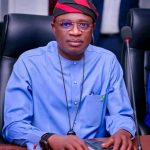
The political landscape of Nasarawa State has shifted seismically: Osana Odonye, a celebrated IMF economist and philanthropist, has yielded to pressure from grassroots mobilization. He finally, joined the African Democratic Congress (ADC).
This raises prospects for scale and potentially marked significant departure from the APC-PDP binary politics. A state historically dominated by both parties, Nasarawa also opens to a “third force” no longer relegated to the fringe but a veritable electoral machine.
The surge of ADC in Nasarawa is not accidental; leadership at the national level had successfully branded the party as a “rescue vehicle” for an electorate that was used and dumped or marginalized by ruling or major parties.
In opening its doors to over 400,000 new members in early 2026, the ADC capitalized on the widespread voter fatigue or internal crises of major parties. ADC has carefully built a coalition of grassroots stakeholders who paired military discipline with global leadership to drive macroeconomic growth and stability.
Odonye brings a unique “technocratic shield” to this burgeoning movement. Having represented Nigeria and several other countries in Sub-Saharan Africa at the International Monetary Fund, his entrance into the race changes the conversation from “whose turn is it?” to
“who can fix the economy?”
Central to his agenda is a “Wealth Creation through Value-Addition,”which proposes a strategic overhaul of the agrarian economy of Nasarawa.
Rather than continuing with subsistence agriculture, Odonye envisions a transition to high-yield agribusiness. Solid minerals and oil prospects for Nasarawa discovered in commercial quantities are more opportunities he would explore. Leveraging Nasarawa’s proximity to the Federal Capital Territory is paramount to transforming the state into a primary food processing hub. Odonye is in lock step in this transformation.
This economic blueprint includes establishing a state-backed agricultural credit scheme anchored by a financially friendly network to cater to framers’ needs. An integrated climate-smart technology is key and would be introduced to ensure year-round productivity.
For the state’s burgeoning youth population, Odonye’s plan pivots a digital economy of the 21st century. Creation of “Innovation Hubs” will be prioritized to provide vocational training in tech and renewable energy.
This dual approach aims to bridge the gap between traditional industry and modern entrepreneurship, transforming Nasarawa’s youthful energy into a productive economic machine.
Besides the professional pedigree, Odonye’s long-standing philanthropy has built a “silent army” of beneficiaries who see his move to the ADC as a path to scaling his private generosity into public policy.
The “pressure” Odonye bowed to was not just from friends, but also from a strategic vacuum created by the major parties.
While the APC remains embroiled in heated debates over zoning with impending implosion and the PDP manages a fragile realignment, the ADC has been marching on both fronts, presenting a “clean” candidate focused on competence over connections or belabored entitlements.
By joining forces with other ADC frontrunners and strategic leaders, Odonye is signaling that the 2027 race will be won on blueprints rather than billboards.
As the campaign headquarters in Lafia begins to buzz with this new development, the ADC has transitioned from a party of protest to a party of professionals, with Odonye Osana positioned as the face of this technocratic revolution.
Nonetheless, the path to the “Lafia House” remains in the horizon of victory. To clinch the ADC ticket, Odonye must navigate a complex internal minefield against high-profile competitors like Bar. Mohammed Hassan Abdullahi and Maj. General Nuhu Angbazo (Rtd).
He faces the classic “Technocrat vs. Politician” divide, where he must convince delegates that macroeconomic expertise outweighs the network of traditional patronage.
Furthermore, he must navigate the volatile zoning sentiments mounted by other vocal voices. The challenge is to ensure that every stakeholder has a voice at the table, and expectations are managed and needs of each zone addressed in a single harmonious Nasarawa.
Whether Odonye can translate his global credibility into local delegate votes remains the ultimate question for 2027.
Chief Ibrahim Nasir
is a Public Affairs Analyst focusing on electoral reforms and democratic governance in Nigeria.