


 News Editor
By David Akoji
As Nigeria edges toward the 2027 general elections, a new and largely uncharted force is entering the democratic arena: Artificial Intelligence (AI).
A scan of Nigeria’s media landscape reveals that, from deepfake videos and automated propaganda to data driven voter engagement and election monitoring, AI is redefining how elections are contested, communicated, and potentially compromised.
While technology has long played a role in Nigeria’s electoral process, the scale, speed, and sophistication of AI tools raise urgent questions: Will AI strengthen electoral credibility, or will it deepen misinformation, manipulation, and mistrust?
Viewed as a Double Edged Sword in Nigeria’s Democratic march towards 2027 elections, Artificial Intelligence offers undeniable benefits. It can enhance voter education, improve election logistics, detect fraud patterns, and even support real time results management. Yet, it also presents unprecedented risks particularly in a country where digital literacy and regulatory frameworks are still evolving.
Stanley Audu, a senior electoral analyst in Abuja warns:
“AI is not inherently dangerous, but in a politically charged environment like Nigeria, it can be weaponized faster than institutions can respond.”
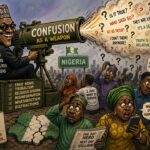
This concern is not hypothetical. Across the globe, AI-generated content, especially deepfakes, has already begun to blur the line between truth and fabrication. In Nigeria’s highly polarized political climate, such tools could easily be deployed to mislead voters or discredit candidates.
Because direct “AI-caused violence” metrics are scarce, researchers rely on proxy indicators:
• 1200% increase in deepfake-related fraud cases in South Africa (2023) 
→ Indicates rapid expansion of AI misuse capabilities, including political manipulation.
• In Nigeria (2019 elections):
• Circulation of deepfake audio of politicians making inflammatory statements
• Contributed to heightened tensions and mistrust 
Drawing from the broader tradition of Nigerian communication scholarship, Professor Desmond Okocha of Bingham University, emphasizes that AI introduces an epistemic and ethical crisis in contemporary media systems, particularly within fragile democracies where regulatory institutions remain weak.
Inside INEC: Prepared but Cautious
The Independent National Electoral Commission is at the center of efforts to safeguard electoral integrity. In an exclusive interview, a highly placed source that prefers not to be named, acknowledged both the promise and the perils of AI.
“Artificial Intelligence can significantly improve election administration,” he said. “But we are equally aware that the same technology can be used to undermine public trust if left unchecked.”
According to him, INEC is already exploring AI-driven tools to enhance voter verification, detect anomalies in voting patterns, and strengthen cybersecurity around election infrastructure.
However, he emphasized caution:
“Our priority is to ensure that technology does not outpace trust. Every innovation must be transparent, accountable, and verifiable by the Nigerian people.”
He also highlighted the growing threat of misinformation:
“The danger of AI-generated disinformation is real. A single manipulated video or text can spread faster than any official correction INEC issues, this is our recent experience. That is why collaboration with media and civil society is critical for us at INEC.”
The Battle for Minds: National Orientation in the Age of AI
Beyond the mechanics of voting lies the more complex challenge of shaping public perception. This is where the National Orientation Agency plays a pivotal role.
In a conversation with the Director General of the agency, Lanre Issa-Onilu, the focus was clear: citizen awareness is Nigeria’s first line of defense against AI manipulation.
“The biggest risk is not the technology itself, but the ability of citizens to distinguish truth from falsehood,, and it is in this regard that we recently launched two AI chatbots, one on our website and another as an app downloadable on android and IOS. The NOA Chatbot is called “CLHEEAN” he noted.
The agency is ramping up public sensitization campaigns ahead of 2027, with a strong emphasis on digital literacy.
“We are educating Nigerians to question what they see online, especially politically sensitive content. If a video looks sensational, it should be verified before it is believed or shared,” Issa-Onilu added.
He also stressed the importance of civic responsibility:
“Democracy cannot survive on technology alone. It depends on informed citizens who are not easily manipulated.”
AI and the New Information Battlefield
The integration of AI into political communication is transforming the electoral landscape into a sophisticated information battlefield. Political actors can now deploy AI tools to:
• Micro-target voters with tailored messages
• Generate persuasive content at scale
• Monitor public sentiment in real time
But these same tools can also be used to distort reality. Deepfake videos, voice cloning, and automated bots can create the illusion of events that never happened.
A digital communication strategist at Bingham University explained:
“In 2027, the question will not just be ‘Who is speaking?’ but ‘Is this even real?’ That uncertainty can erode trust in the entire electoral process.”
Global Lessons, Local Stakes
Nigeria is not alone in facing these challenges. Democracies around the world are grappling with the implications of AI in elections. However, Nigeria’s context, marked by high political stakes, diverse populations, and uneven access to information, makes it particularly vulnerable.
Unlike more technologically regulated environments, Nigeria’s digital space remains relatively open, increasing both innovation and exposure to risk.
Regulation, Responsibility, and Readiness
Addressing the AI challenge requires a multi-stakeholder approach:
• INEC must strengthen technological safeguards and transparency mechanisms
• Government regulators must update legal frameworks to address AI misuse
• Media organizations must enhance fact-checking and verification processes
• Citizens must develop critical digital literacy skills
As the source from INEC puts it:
“Election integrity in the digital age is a shared responsibility.”
Cause for Worry or Opportunity for Reform?
Artificial Intelligence is neither inherently a threat nor a solution. Its impact on Nigeria’s 2027 elections will depend on how it is managed.
For some, it represents a looming danger to democratic stability especially in the backdrop of some of the things we are already beginning to see in the digital landscape. For others, it offers an opportunity to modernize and strengthen electoral systems and to further democratize the election process.
DG NOA, Lanre Issa-Onilu offered a balanced perspective:
“We should not fear technology, but we must not be naïve about it either. The goal is to harness its benefits while protecting our democracy from its excesses.”
The Future of Nigeria’s Democracy in an AI Age
As the countdown to 2027 continues, Nigeria stands at a critical intersection of technology and democracy. Artificial Intelligence will undoubtedly shape the election, but whether that influence is constructive or corrosive remains to be seen.
What is clear, however, is that the integrity of the electoral process will depend not just on machines and algorithms, but on institutions, regulation, and the vigilance of the Nigerian people.
Because in the end, the most powerful safeguard against manipulation is not artificial intelligence, but collective human awareness and this is where the job of the National Orientation Agency is clearly defined.
David Akoji, is a PhD student at Bingham University, Karu, Nasarawa State
Call to donate, sponsor posts or for advert placements on our website.
Tel: +234 815 089 8880.
Thank you!