



 News Editor
By Ibrahim Nasiru
In my previous article, “From Ekiti to Abuja: The Stomach Infrastructure Revolution,” I talked about how basic survival has been turned into a weapon in Nigerian politics. The piece got a lot of people talking.
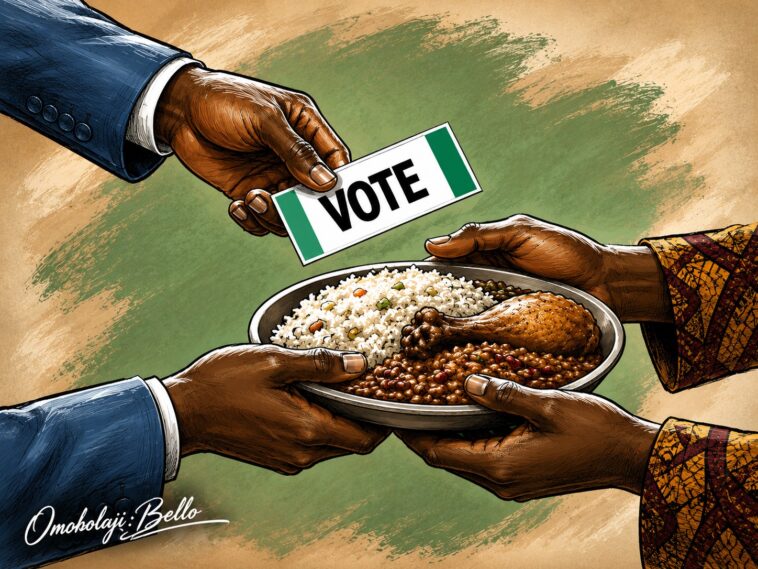
One reader hit the nail on the head, warning that “when you sale your today as a result of hunger, you risk the tentacles of your tomorrow.” The reader left me with a huge question that we cannot ignore: Why should stomach infrastructure never be the standard for picking a leader, and what exactly does it do to the future of our democracy?
Let’s break down the real price we pay when we swap our future for a plate of food. People who defend stomach infrastructure like to use empathy as an excuse. They ask how a hungry person can appreciate a newly tarred road if they do not live to walk on it.
Yes, taking care of people is the main job of government, but relying on handouts at election time is a massive trap.
For one, it is a business transaction, not governance. A handout happens once. A politician who gives you a bag of rice today has settled his business with you. For the next four years, he does not owe you a single thing.
Secondly, it thrives on poverty that leaders create on purpose. If a politician fails to build schools, create jobs, or secure our farms, they keep everyone broke. Then, they show up during elections to “rescue” you from the exact poverty they caused, using cheap food to buy your loyalty.
Finally, it makes no sense mathematically. A 10,000 Naira note or a carton of noodles cannot feed your family for four years. When you take it, you are trading 1,460 days of a better life for just two days of food.
When stomach infrastructure becomes how we play politics, governance completely rots. Good people with great ideas get pushed out entirely.
The system makes it so that only the highest bidder wins, not the best brain. Brilliant leaders who actually know how to fix hospitals, security, and jobs are blocked from office simply because they refuse or cannot afford to hand out cash on the streets.
This means politics becomes a risky business venture. If a candidate spends billions of Naira feeding an electorate to win an election, the very first thing he will do in office is to pack public funds to pay back his sponsors and recoup his money.
Money meant for hospitals and schools disappears. Worst of all, accountability dies.
You cannot complain about bad roads, electricity, or insecurity to a leader whose food you already ate. When leadership is bought like a commodity, you lose the right to complain.
You cannot demand performance from a politician when you are already holding his receipt.
Breaking this cycle means we must stop relying on political charity and start demanding real structural development. People will stop complaining when the economy actually works for them, not when they get a bag of rice.
We need to start looking at our vote as a seed, not a meal ticket. If we eat the seed today, we will definitely starve tomorrow.
Democracy works when we build a society where anyone can succeed through hard work and equal opportunity. That kind of society can never be built on the crumbs of stomach infrastructure.
It is time to stop voting for the hand that feeds us for a day, and start voting for the minds that can empower us for a lifetime.
Vote for the mind that empowers, not the hand that feeds.
Chief Ibrahim Nasiru
A Public Affairs Analyst writes from Abuja.
Call to donate, sponsor posts or for advert placements on our website.
Tel: +234 815 089 8880.
Thank you!