



 News Editor
By Ibrahim Nasiru
Few subjects generate as much raw emotion in contemporary Nigeria as the periodic debate over the country’s economic and political breakdown.
Every few months, like clockwork, commentaries emerge suggesting that Nigeria would be better served by disintegration, or that one specific region is a parasitic anchor dragging down the rest. These arguments are almost always presented with an air of mathematical certainty, as though the fate of over 220 million people can be neatly reduced to a simple balance sheet of crude oil versus cows.
This lazy, reductionist approach to nationhood is what we must call “Arithmetic Federalism.” It is the dangerous delusion that a modern state is merely an equation of geography and natural resources, rather than a complex, living ecosystem of human capital, markets, and supply chains.
The central thesis of this narrative, usually aimed at proving that Northern Nigeria cannot economically survive without the South, is not an established economic fact. It is a highly debatable political proposition masquerading as a settled truth.
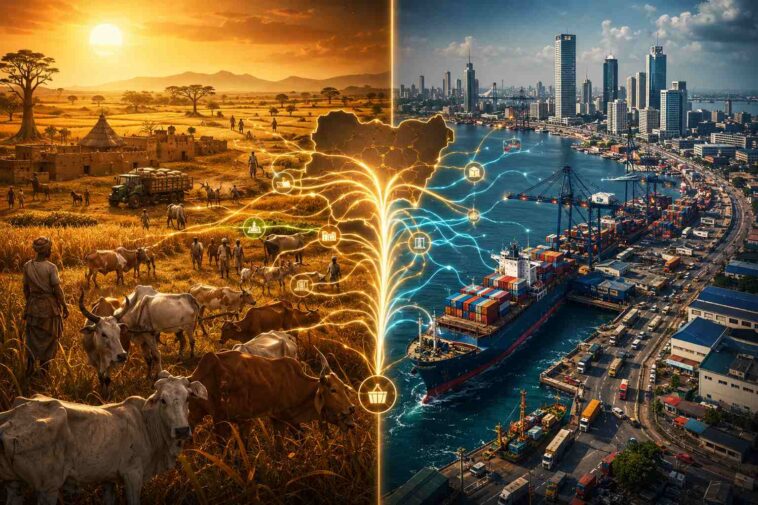
A rigorous, objective analysis of the country’s internal trade dynamics reveals a completely different reality: Nigeria is not a collection of independent islands. It is a deeply integrated, symbiotic economy where the prosperity of one region is the literal foundation for the prosperity of the other.
To suggest that the North cannot survive independently is to ignore the basic laws of global economics. In discussions about regional viability, commentators frequently weaponize geography, pointing out that the North is landlocked as if it were an automatic death sentence.
Yet, history and modern economics show that being landlocked has not stopped nations like Switzerland, Austria, or Rwanda from building immense economic sovereignty.
The North possesses an unbreakable economic foundation: it holds the agricultural backbone of West Africa, vital trans-Saharan commercial transit routes, and a staggering demographic market power. The regions are completely interdependent.
Northern agricultural production, supplying the grains, livestock, tubers, and vegetables that feed the nation—is the very security blanket that prevents massive urban unrest in the South.
Conversely, Southern manufacturing, banking, and maritime infrastructure rely entirely on the massive consumer market of the North to achieve profitability.
Lagos may be the commercial gateway and Port Harcourt the petroleum anchor, but Kano remains one of West Africa’s largest trading hubs, and Kaduna remains a vital manufacturing artery.
The South does not fund the North, and the North does not carry the South. It is a closed-loop ecosystem. One cannot bleed without the other dying.
The real bottleneck confronting Nigeria has never been our geography, our diverse ethnicities, or our regional boundaries. The crisis we face is institutional. It is the chronic, systemic failure of successive governments to convert our staggering regional advantages into localized wealth.
We do not suffer from an unviable map; we suffer from over-centralized governance that suffocates local productivity and traps regional wealth in bureaucratic bottlenecks.
The path forward for Nigeria does not lie in emotional narratives of regional superiority or threats of partition. The proper response to our national dissatisfaction is radical structural reform.
We do not need to tear down the house; we need a radical decentralization of economic power. We need a system where every region has the fiscal autonomy to exploit its unique strengths—whether that means drilling for oil, mining solid minerals, or revolutionizing mechanized agriculture—without waiting for validation from an oversized central government.
“Arithmetic Federalism” is a intellectual failure. It reduces the grand experiment of Nigerian unity to a petty ledger of grievance. The wealth of this country is not buried solely in the oil wells of the Niger Delta or scattered across the fertile fields of the Savannah. The ultimate wealth of Nigeria is the scale of its unified market.
To break that scale based on flawed mathematical models is not just political recklessness; it is economic suicide. It is time to retire the calculators of division and pick up the blueprints for true, decentralized development.
Chief Ibrahim Nasiru
A Public Affairs Analyst writes from Abuja
Call to donate, sponsor posts or for advert placements on our website.
Tel: +234 815 089 8880.
Thank you!