


 News Editor
By Chief Ibrahim Nasir
(A Public Affairs Analyst)
For sixteen years, the People’s Democratic Party (PDP) was not just a political party; it was more than an institution as hard as the rock of gibraltar.
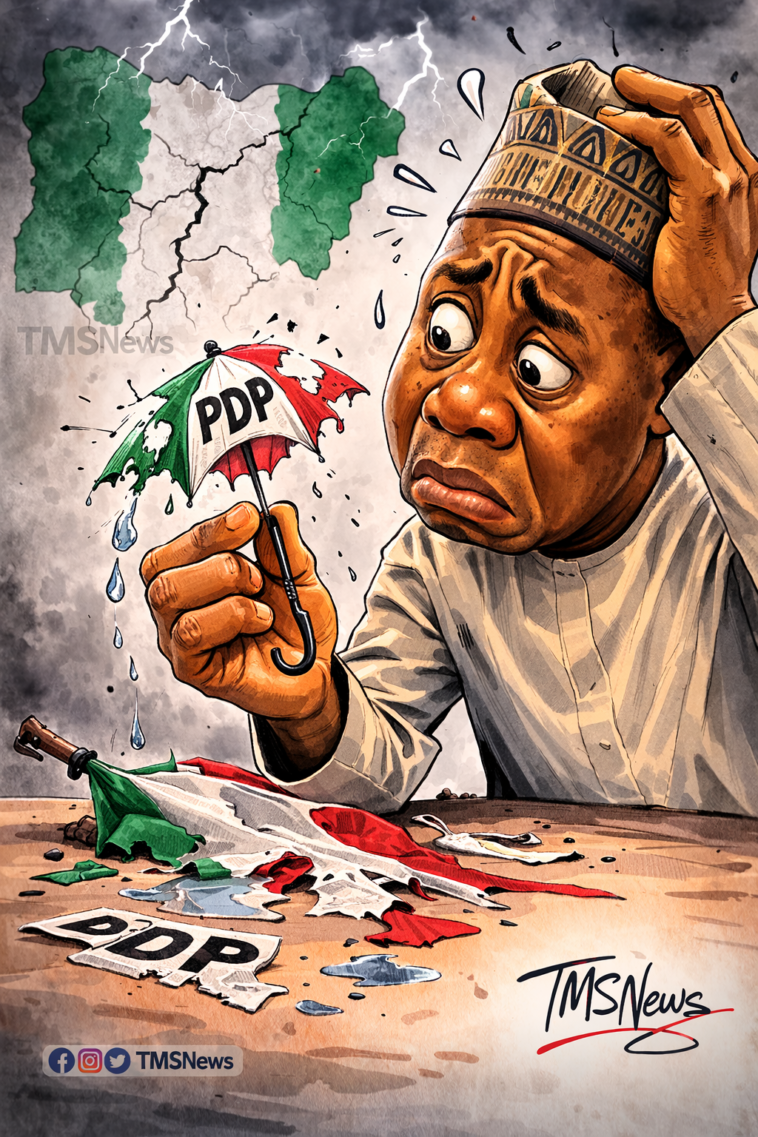
Self-styled as the “largest party in Africa,” its umbrella was wide enough to house diverse interests from the creeks of the Niger Delta to the arid plains of the Sahel.
But as the 2027 electoral cycle looms, that umbrella appears torn, and the party that once boasted it would rule for sixty years is now fighting for its very breath.
The current state of the PDP is a masterclass in political friction, characterized by a high-stakes tug-of-war between the FCT Minister, Nyesom Wike, and the PDP Governors’ Forum. This isn’t just a disagreement over policy; it is a battle for the soul of the party.
On one side, the Wike-aligned faction wields significant legal and strategic influence, maintaining a grip on the party’s administrative machinery that many critics argue serves the interests of the ruling APC.
On the other side, the Governors—led by figures like Bala Mohammed and Seyi Makinde—are fighting to “reclaim” the party for its traditional base.
This internal “Cold War” has created a leadership dualism where court orders carry more weight than party resolutions.
When a party spends more time in the High Courts than in the grassroots, its “inroads” into the next election become mere potholes.
Beyond the internal drama, the PDP’s crisis has created a dangerous vacuum in Nigeria’s democracy: the absence of a potent “watchdog.”
A vibrant opposition is the heartbeat of a healthy republic, yet the PDP is too busy nursing its own wounds to hold the government to account.
While the nation grapples with economic shifts and policy changes, the “official opposition” is curiously silent or, worse, distracted by ego-driven litigation.
When the shadow cabinet is more interested in who signs the party’s bank cheques than in critiquing the national budget, the ruling party is essentially given a “free pass.”
The PDP’s inability to speak with one voice means the Nigerian voter is left without a clear alternative or a shield against executive excesses.
Can the PDP make an inroad in 2027? The answer is a cautious “yes,” but only if it undergoes a radical “surgical reconciliation.”
The party still possesses a brand name that resonates in every local government in Nigeria.
However, a brand name without a unified structure is just a ghost.
To be a threat in 2027, the PDP must resolve the “Wike Factor” once and for all and present a unified front. Most importantly, it must lead the charge for an opposition coalition.
In the current winner-takes-all climate, a fragmented opposition is a gift to the incumbent.
The PDP is at its most existential moment since 1998. It can either choose the path of restoration—by burying the hatchet and returning to its founding principles—or it can continue its slide into political relegation.
As the INEC clocks tick toward the May 2026 primaries, the umbrella is leaking.
If the PDP doesn’t fix the roof now, it won’t just lose the 2027 election; it might lose its place in history altogether.
Call to donate, sponsor posts or for advert placements on our website.
Tel: +234 815 089 8880.
Thank you!