



 News Editor
By Ibrahim Nasiru
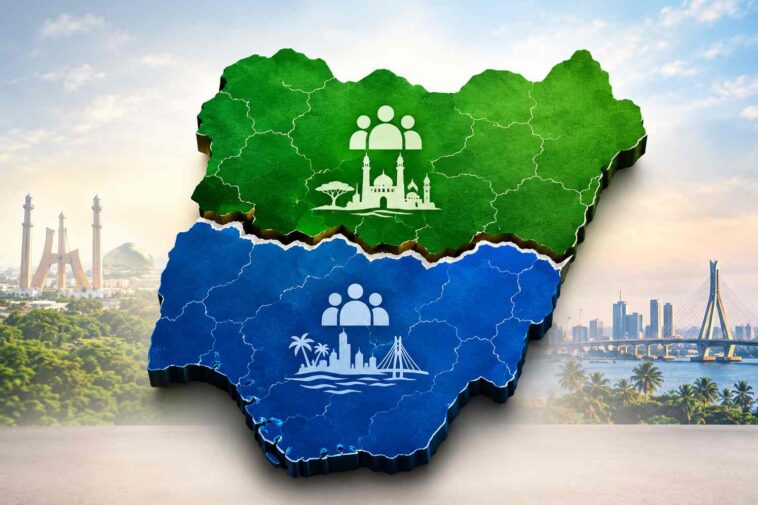
The growing fatigue with Nigeria’s complex federal structure has recently given rise to a dangerous and defeatist intellectual trend within the national discourse. Commentators like Mohammed Bello Doka have gone as far as advocating for the outright dissolution of the federation, claiming that cutting the federal lifeline is the only operational way to force internal accountability and governance sense within Northern Nigeria.
The argument posits that if the region is pushed into a “sink or swim” corner, its political class will automatically discover structural discipline. While this thesis stems from a valid, deeply felt frustration with elite mediocrity, systemic poverty, and institutional stagnation, its core conclusion remains a dangerous mirage. Running away from a shared house because the roof is leaking does not build a new structure; it merely exposes the inhabitants to harsher elements.
The fundamental flaw in the pro-division argument is the naive, unscientific belief that geography cures bad governance. Breaking Nigeria into smaller sovereign units will not magically eliminate corruption, reverse the weaponization of poverty, or institutionalize meritocracy. If a local political elite cannot efficiently manage public resources within a federal framework, drawing a new international border around them will simply create a smaller, more concentrated rentier state.
Continental and global history proves this tracking clearly. When South Sudan separated from Sudan after decades of structural frustration, the promise of self-determination quickly dissolved into internal factional warfare and governance paralysis. Similarly, when Eritrea severed ties with Ethiopia in 1993 under the illusion that its strategic ports would guarantee autonomy, it merely institutionalized a highly closed, economically stagnant autocracy.
From the volatile fragmentation of the Balkan states to Pakistan’s chronic post-partition institutional fragility, the lesson remains unyielding: the problem was never the border; it was the failure to transition from a culture of political patronage to one of institutional productivity.
Furthermore, the economic arithmetic of sudden regional fragmentation ignores the immediate fiscal precarity of the sub-region. Currently, the vast majority of the nineteen Northern states rely heavily on monthly distributions to fund their recurrent expenditures, including civil service salaries and basic overheads. Abruptly severing this fiscal spine under the guise of an academic experiment in self-reliance would induce an immediate liquidity shock. It would paralyze local governance before any sustainable internal revenue generation (IGR) frameworks could be established.
True regional transformation does not require the structural trauma of secession or fiscal collapse; it requires the systematic dismantling of a political culture that prioritizes consumption over tangible production.
The North does not need to drown to learn how to swim. The region is already equipped with the foundational elements of global economic autonomy: immense arable land, strategic solid mineral wealth, a massive youth demographic, and vital international trade corridors. The actual challenge is a failure of economic execution by its sub-national leadership.
Instead of indulging in the academic fantasy of sovereign division, intellectual leaders must demand an unyielding, production-first blueprint from the current political class. This means holding regional governors strictly accountable for transforming the vast agrarian belts into self-sustaining processing hubs, securing local distribution networks, and building robust tax bases independent of crude oil revenues.
Ultimately, the battle line ahead of the 2027 political cycle is not between different geographic regions or ethnic enclaves, but between productivity and stagnation. The challenges of inflation, insecurity, and institutional decay are uniquely Nigerian crises that require unified, context-specific policy execution—not structural abandonment.
Retreating into regional enclaves under the guise of finding internal logic is a concession to failure. Nigeria’s diversity remains a profound economic asset if managed through absolute contractual sanctity, infrastructural integration, and strict fiscal discipline.
The path to regional salvation lies in fixing the federal engine, not in wrecking the vehicle.
Ibrahim Nasiru
Public Affairs Analyst
Call to donate, sponsor posts or for advert placements on our website.
Tel: +234 815 089 8880.
Thank you!