


 News Editor
By Ibrahim Nasiru
The basic premise of economic governance is that capital allocation must mirror the productive realities of the population.
When an administration spends billions on elite, high-altitude monuments while the agrarian grassroots lacks basic farm-to-market roads, functional healthcare clinics, and decent schools, it is building an unsustainable economic mirage.
In Nasarawa State, where the fiscal budget scales past an unprecedented ₦545.2 billion under the banner of “Strategic Consolidation,” a deep systemic disconnect has emerged.
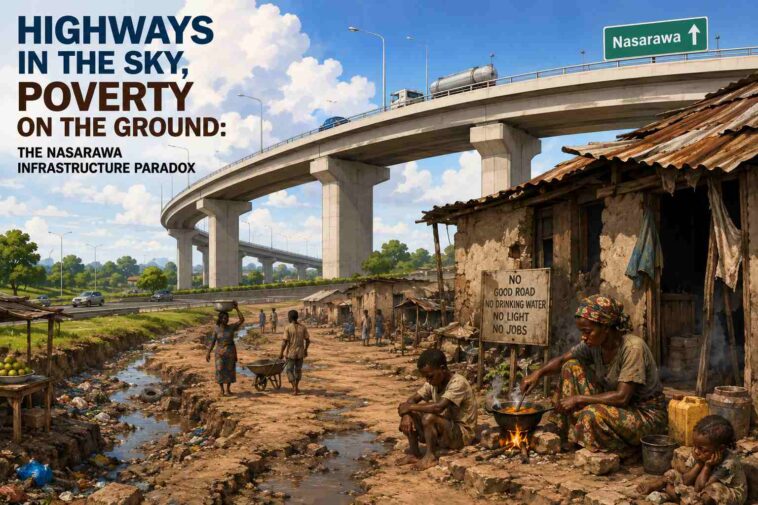
The state’s current development model presents a classic, tragic paradox. It is a top-heavy push for marquee capital monuments existing alongside staggering human capital poverty on the ground.
The ultimate symbol of this misallocation remains the Lafia Cargo Airport project.
Commissioned amid intense political fanfare, the multi-billion naira facility has consistently struggled to justify its existential maths. It frequently remains an incomplete, overgrown asset primarily used for the occasional private jet of political actors.
While the federal government’s recent ₦9.75 billion takeover refund provided a superficial fiscal cushion, it does not erase the flawed operational philosophy that birthed the project.
Air cargo requires advanced, integrated cold-chain logistics, world-class processing hubs, and export-grade agricultural standardization.
You cannot export agricultural produce via “highways in the sky” when the physical roads leading from the actual farms in Obi, Keana, Awe, and Doma are routinely washed out by neglect.
Nasarawa is naturally positioned to be the undisputed food basket feeding the massive, hungry consumer market of the Federal Capital Territory (FCT).
Yet, because capital expenditure remains heavily concentrated on elite highway corridors and urban prestige projects, the state’s agrarian backbone faces total market isolation.
Smallholder and subsistence farmers cannot move yams, cassava, and sesame seeds out of their local enclaves before they rot. Up to 40% of seasonal harvests perish on the ground due to the complete absence of rural storage infrastructure and passable access networks.
The state is effectively suffocating its primary source of internal revenue generation, trading long-term agricultural velocity for immediate political optics.
This structural blind spot becomes even more alarming when you look at the decay of the state’s real infrastructure—its human capital.
As I always focus on in my system and institutional audits, infrastructure is only valuable if it serves as a direct catalyst for productivity.
Under the current budget allocations, the ₦145 billion thrown at hard infrastructure dwarfs the combined resources left for the fundamental building blocks of human survival. Public health, allocated a meager ₦37 billion, and agriculture, left with just ₦31 billion, are being systematically starved to fund asphalt.
Across rural Nasarawa, primary healthcare centers are dilapidated, roofless structures lacking essential drugs, basic diagnostic tools, and qualified personnel. Public schools are similarly bankrupt, forcing children to learn on bare floors under compromised structures.
You cannot build a modern, competitive economy with a population stunted by poor health and systemic illiteracy.
The recent, hurried approval of a ₦52 billion supplementary budget for rural infrastructure projects is a quiet admission that the basement of the house is crumbling.
However, papering over massive structural cracks with emergency interventions right before election cycles is not a sustainable development strategy.
True economic emancipation does not begin by trying to fly out of poverty when the feet of your citizens are firmly stuck in the mud of rural isolation and institutional neglect.
The presidency, state administrators, and citizens must begin demanding raw institutional accountability over convenient political showmanship.
True wealth creation begins on the ground, by fortifying the human capital, local classrooms, and rural pathways that keep the real economy breathing. Until we invert this top-heavy governance model, our grand infrastructure designs remain empty monuments to mismanaged opportunities.
Chief Ibrahim Nasiru
A Public Affairs Analyst writes from Abuja
Call to donate, sponsor posts or for advert placements on our website.
Tel: +234 815 089 8880.
Thank you!